





Perception of Societal Risk in Turkey
Authors: Vuslat Haz Alibaşoğlu, Emre Turan, Daniela Kızıldağ & Ceylan Engin
*Department of Sociology, Boğaziçi University
Funders of research: Our project is funded by TUBITAK 1001, with the grant number 223K65.
Click here to access the PDF version of this report
Threats such as the pandemic, technology, and the climate crisis shape the perception of societal risk at both local and global scales. Drawing on Ulrich Beck’s “risk society” theory, it can be observed that while modern institutions strive to manage risks, their very structures simultaneously generate new uncertainties, such as concerns regarding artificial intelligence or information security (Beck, 1992; Beck, 1999). Heightened levels of anxiety, coupled with an intensified sense of uncertainty and threat, serve to normalize alternative narratives, like conspiracy theories, transforming them into routine beliefs (Douglas, Sutton, and Cichocka, 2017; van Prooijen and Jostmann, 2013).
This report is based on data from the "Health, Environment, Science, and Technology" (TSVS) section, which examines how global crises, the pandemic, and technological advancements have shaken public trust in institutions. The TSVS survey was conducted in 2024 with 1,587 participants through face-to-face interviews. As part of the survey, participants were asked about their levels of concern regarding the pandemic, stray dogs, artificial intelligence, and climate change, using a scale where 1 means "not concerned at all" and 5 means "very concerned."
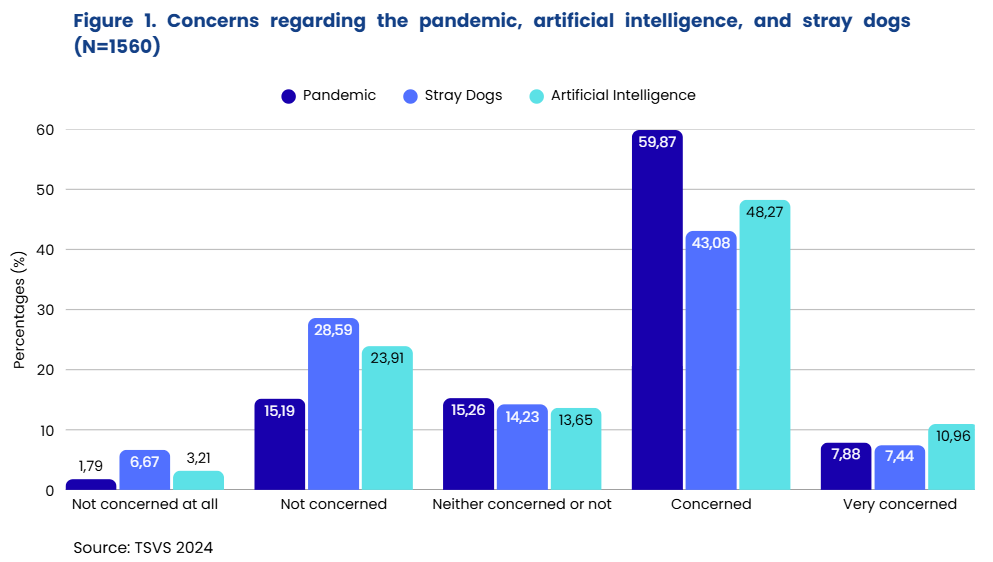
Figure 1 illustrates the distribution of concerns regarding the pandemic, artificial intelligence, and stray dogs. 67.53% of participants indicated that they are concerned or very concerned about the possibility of another pandemic occurring in the coming years. The portion of those concerned about the increasing use of artificial intelligence in daily life stands at 58.96%, while concerns regarding the number of stray dogs rank third at 50.80%. It appears that the risk of a pandemic is the primary source of concern across the general population.
The higher level of concern regarding the pandemic in Turkey, compared to the levels of concern regarding artificial intelligence and stray dogs, may stem from the fact that pandemic related anxieties can reach much broader audiences through channels such as the media. Furthermore, given that the survey was conducted in 2024, the topics of artificial intelligence and stray dogs represent more recent issues; consequently, individuals' levels of concern regarding these subjects may not yet have been as significantly shaped by these emerging topics as they have been by the pandemic. The elevated level of concern surrounding the pandemic may also be linked to the degree of trust placed in the risk management efforts of institutions (Liu et al., 2022).
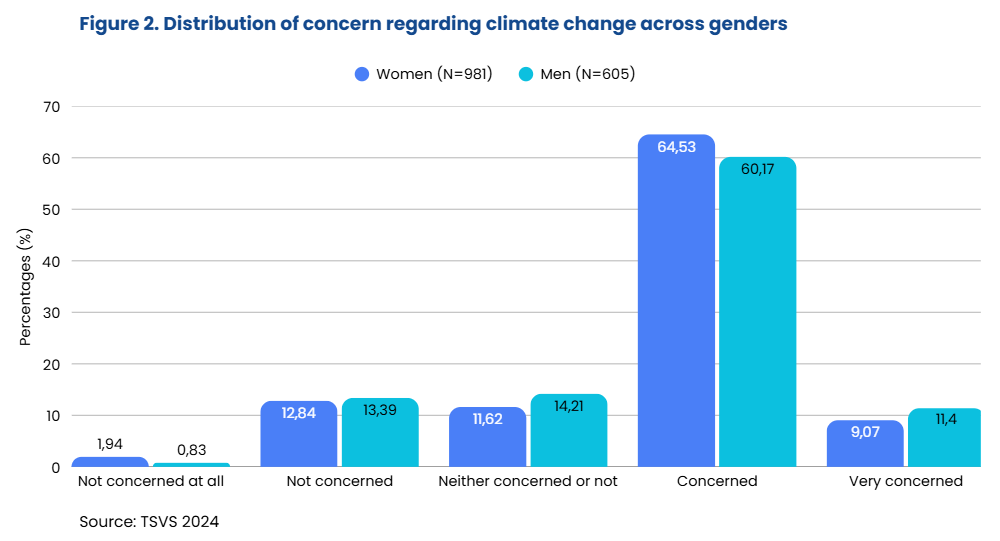
Figure 2 illustrates the distribution of concern regarding climate change by gender. The portion of respondents who indicated that they are "concerned" about climate change is 64.53% for women and 60.17% for men. Conversely, the portion of those who stated they are "very concerned" is higher among men (11.4%) than among women (9.07%). When both categories are considered together, it is observed that 73.60% of women and 71.57% of men express concern about climate change. The portion of those who remain undecided ("neither concerned or not") is 14.21% for men and 11.62% for women.
These data indicate that concern regarding climate change does not differ significantly between men and women; anxiety levels are quite high in both groups. While women are slightly more likely to respond that they are "concerned" and men that they are "very concerned," the overall levels of concern are similar. This finding can be explained by the fact that the climate crisis is perceived as a shared threat across society. The fact that information about climate change reaches both men and women in a similar manner, through channels such as the media, may have prevented the emergence of a sharp gender divide. Nevertheless, it is worth noting that the overall level of concern is slightly higher among women (73.60%) than among men (71.57%). Existing research also suggests that women tend to experience somewhat higher levels of concern regarding climate change compared to men (McCright, 2010).
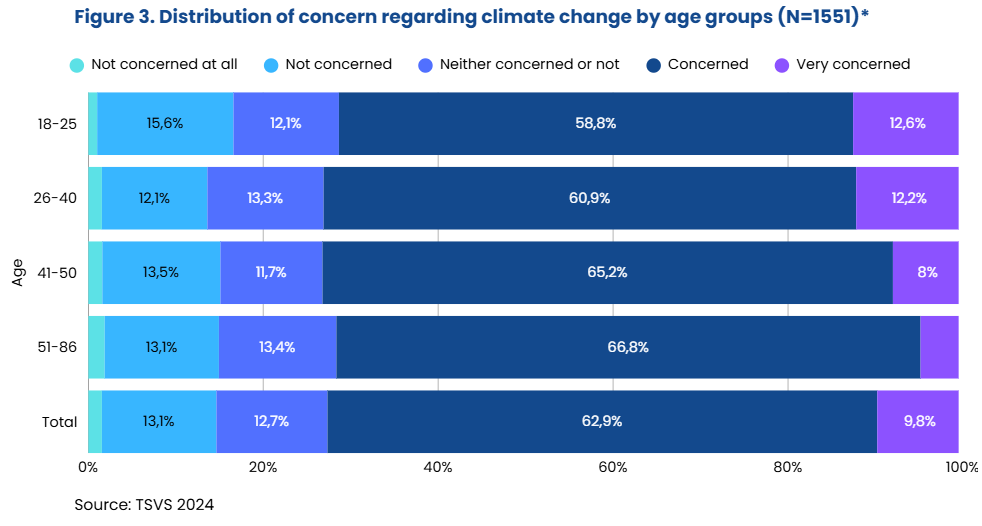
The distribution of responses to the statement "Not concerned at all" by age group is 1.01% for the 18–25 age group, 1.55% for the 26–40 age group, 1.60% for the 41–50 age group, and 1.87% for the 51–86 age group.
Figure 3 illustrates the distribution of concern regarding climate change across different age groups. One of the most striking findings in the study, within the context of a very high overall level of awareness (73%), is how this concern is distributed among various age groups. While the level of concern about climate change remains high across all age groups, the 18–25 age group exhibits a heterogeneous distribution, encompassing polarized attitudes. This group has the highest portion of individuals (12.56%) who report being "very concerned" about climate change. Conversely, when examining participants who state that they are not concerned, the 18–25 age group again accounts for the largest share, at 15.58%.
These data indicate that the younger age group is not homogeneous regarding climate anxiety; rather, it encompasses both the highest and lowest levels of concern. This may be attributed to differences in how young people access information, as well as the diversity in their anxieties about the future. In the case of those who responded "not concerned at all," it is possible that their lack of personal experience with past climate conditions, like having been born and raised in a world where the climate crisis is already an established reality, contributes to this lower level of concern. Beyond the youth, the high level of anxiety regarding climate change across Turkey can be explained by a high degree of societal awareness. It is also observable that the portion of individuals who report being "very concerned" decreases with age. This decline may be influenced by the fact that older individuals tend to have lower rates of accessing information about climate change. Furthermore, research indicates that the perception of risk tends to diminish with advancing age (Shin and Kim, 2023).
This study reveals that, in Turkey, levels of concern regarding global and technological risks such as the pandemic, the climate crisis, and artificial intelligence remain high across society. While the overall levels of concern regarding the climate crisis are similar for both women (73.60%) and men (71.57%), the fact that the highest rates of concern decline with age, and that the 18–25 age group encompasses both the highest (12.56%) and lowest (15.58%) levels of concern, indicates that risk perception varies according to demographic variables. These findings suggest that the uncertainties generated by modern risks have a direct bearing on the risk-management capacity of institutions and the level of public trust placed in them. Indeed, as emphasized in the theoretical literature, heightened uncertainty and risk perception, particularly when trust in institutions weakens, create fertile ground for the emergence of conspiracy theories and alternative narratives.