
Gendered Trust in Public Institutions
Authors: Daniela Kızıldağ, Sena Akkoç, & Ceylan Engin
Funders of research: Our project, coded 21B08SUP2, is funded by BU Scientific Research Projects.
Click here to access the PDF version of this report
Using the Turkish COVID-19 Values Survey (TCVS), we examine the level of trust in public institutions in Turkey, and how the level of trust differs by gender. The TCVS was conducted face-to-face with 1500 participants in 2022.
Figure 1 shows the distribution of trust levels in public institutions. Individuals' trust in institutions was measured on an 11-point scale, where 0 means "Absolutely distrust" and 10 means "Absolutely trust." On this scale, responses from 0 to 3 indicate "low trust," 4 to 6 indicate "moderate trust," and 7 to 10 indicate "high trust."
Among the public institutions listed, the police is the most trusted institution. While 50.79% of participants have high trust in the police, this rate drops to 30.94% for the legal system, 31.33% for the government, and 24.94% for political parties. The percentage of those who report low trust the government is 39.18%, while the percentage of those who do not trust the police is 17.27%, which is the lowest rate among all public institutions.
Figure 1. Trust in public institutions
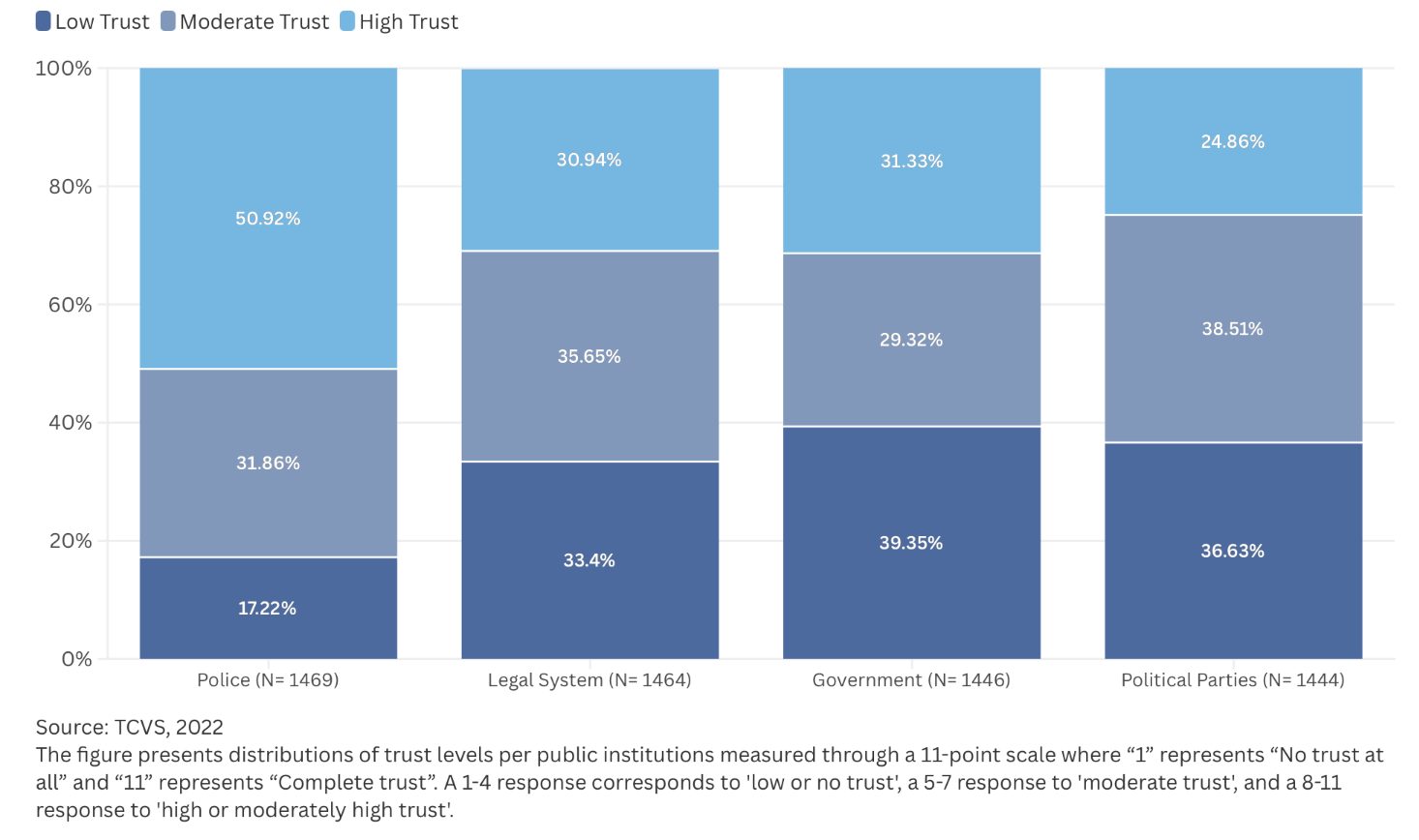
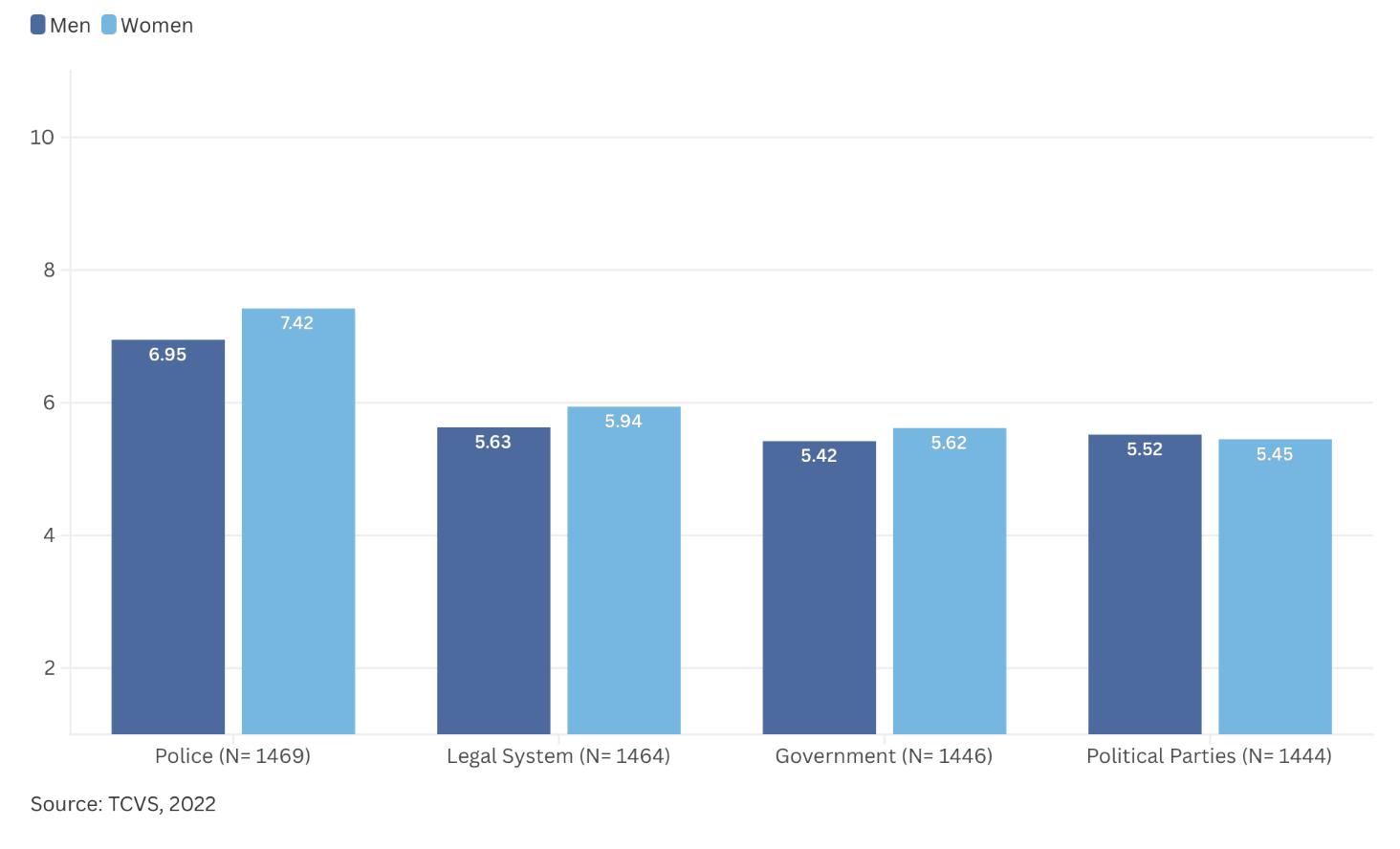
Figure 2. shows that the averages of trust levels per public institution by gender. Women have slightly higher trust in all public institutions except political parties. However, the gender difference is significant only for trust in the police. This may be due to the differences in the frequency and reasons for women's and men's interactions with the police.
Figure 2. Average trust in institutions by gender
In Turkey, trust in the police and the judicial system is higher among public institutions than in political parties and the national government, which is similar to trust levels in OECD countries (2024). A certain level of skepticism toward public institutions is an integral part of democratic values. However, trust in public institutions is often used as an indicator of how well democracies function and how well public administrations perform. Therefore, efforts to increase trust should be prioritized to ensure the legitimacy of democratic institutions.
Sociology Data Lab (SDL)
Boğaziçi University
References: OECD (2024), OECD Survey on Drivers of Trust in Public Institutions – 2024 Results: Building Trust in a Complex Policy Environment, OECD Publishing, Paris, https://doi.org/10.1787/9a20554b-en.