
Public Perceptions of Wildfire Causes
Authors: Daniela Kızıldağ, Cansu Mine Yıldırım, Sinan Erensü & Ceylan Engin
Funders of research: Our project, with the grant number 223K652, is funded by TUBITAK 1001.
Click here to access the PDF version of this report
In 2021, Turkey experienced its largest wildfire in its history in Manavgat, burning down around 27.000 hectares of land (Türkiye Ormancılar Derneği 2024), and, although in a smaller scale, a similar wave of wildfires blazed through Turkey in the summer of 2025. Climate change and related extreme weather events such as droughts and high temperatures have been reported to increase fire frequency (Jones et al. 2022). Recent decades have also seen an increase in the frequency, intensity, and duration of heat waves and temperature extremes in the Mediterranean Basin, especially during the summer, and these trends are projected to persist (Ali et al. 2022).
Using the Turkish Social Values Survey (TSVS), we examine people’s perceptions of the most common causes for the wildfires that happen in Turkey and how the most common causes differ by gender, political party choice, and interpersonal trust. The TSVS was conducted face-to-face with 1587 participants in 2024. In the survey, participants were provided with four options for the most common possible causes of wildfires, which were climate change, acts of terrorism, individual carelessness, and rent-seeking purposes.
Figure 1. Distribution of perceptions on the most common cause for wildfires by gender
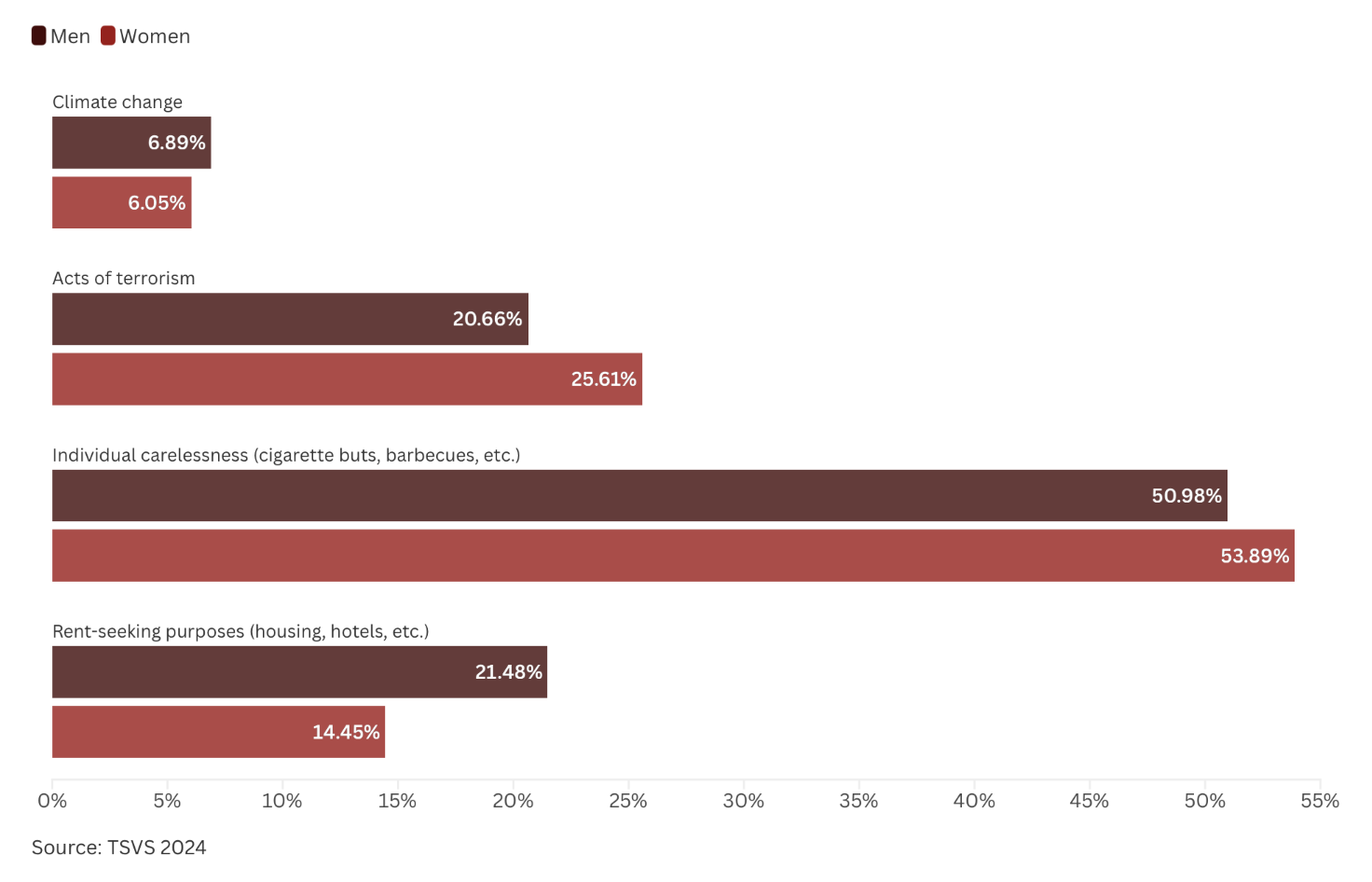
Figure 1 shows the distribution of the perceived most common cause for wildfires by respondents’ gender. There are significant differences between men and women for the most common perceived cause of wildfires. However, this association is not strong, and majority of men and women choose “individual carelessness” as the most common cause. Yet, women (25.61%) are more likely than men (20.66%) to attribute wildfires to acts of terrorism. Furthermore, men report rent-seeking purposes (21.48%) as the most common cause compared to women (14.45%).
Claims related to terrorism or rent-seeking often circulate rapidly after wildfires, in the form of conspiracy theories (Türkmen 2021), and these claims have rarely substantiated. Previous research has reported mixed findings on gender differences in belief in conspiracy theories (Galliford and Furnham 2017; Tam and Lee 2023). Our results suggest that such inconsistencies may stem from differences in the content or framing of specific conspiracy theories, pointing to possible gender-based variations in susceptibility depending on the topic.
Figure 2. Distribution of perceptions on the most common cause for wildfires by political party choice
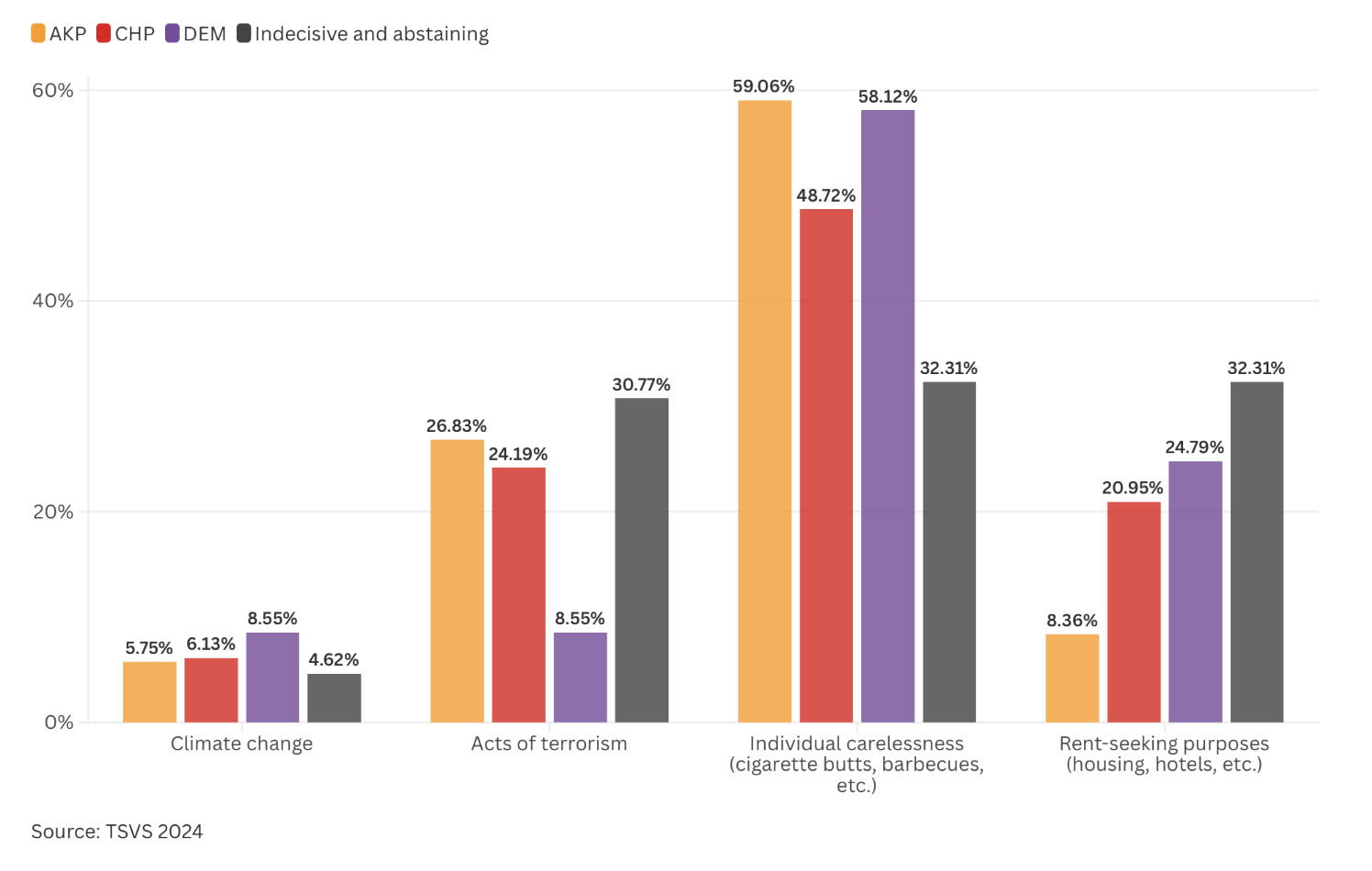
Figure 2 presents the distribution of perceived primary causes of wildfires according to respondents’ political party choice. Across all political party constituents, “individual carelessness” was the most commonly cited reason for wildfires. This reason was stated slightly more frequently by participants who are part of the AKP’s (Justice and Development Party) constituency (59.06%) than those who voted for DEM (Peoples' Equality and Democracy Party) (58.12%), the CHP (Republican People’s Party) (48.72%), or indecisive and abstaining participants (32.31%). Meanwhile, “climate change” was the least frequently cited reason across all political party constituents, with only 8.55% of DEM voters, 6.13% of CHP voters, 5.75% of AKP voters, and 4.62% of indecisive or abstaining participants indicating this reason.
It is reported that while only 10% of the wildfires are naturally-driven, 90% are caused by intentional or unintentional human activities (Ekberzade 2025), which include both individual activities and commercial practices, such as energy facilities that are close to or within forested areas. The particular reason of the 48.30% of anthropogenic forest fires have not been identified, and among intentionally caused wildfires, only 0.18% have been attributed to terrorism (Atmış, Tolunay, and Erdönmez 2023). This indicates a vast overrepresentation in people’s perception regarding acts of terrorism as a cause of wildfires.
Moreover, after a forested area is impacted by wildfires, it is protected under Article 169 of the constitution, can’t be rented or used for commercial purposes and efforts for reforestation must be made (Tolunay 2022). Therefore, areas affected by wildfires cannot be used for rent-seeking purposes. However, forests that have not been impacted by fires can be rented or allocated for non-forestry uses, such as energy and mining operations and touristic enterprises, none of which is reflected in deforestation statistics (Atmış, Yıldız, and Erdönmez 2024).
Among different party voters, the most common cause of wildfires present a polarized pattern in which each party’s voter base refrain from pointing to a cause that their party’s supporters or policies have been linked to. For instance, on various social media platforms, allegations have surfaced that the AKP government has deliberately started the 2025 wildfires for profit (Yıldızalp and Bal 2025). At the same time, AKP voters cited “rent-seeking purposes” the least (8.36%) compared to voters of other parties. While the DEM party has long faced allegations of supporting terrorism (Hürriyet 2023), among its voters, “acts of terrorism” was the least commonly cited reason for wildfires (8.55%). Hence, these findings suggests that voters tend to avoid wildfire causes that are attributed to the party that they are affiliated with.
Figure 3. Distribution of perceptions on the most common cause for wildfires by interpersonal trust levels
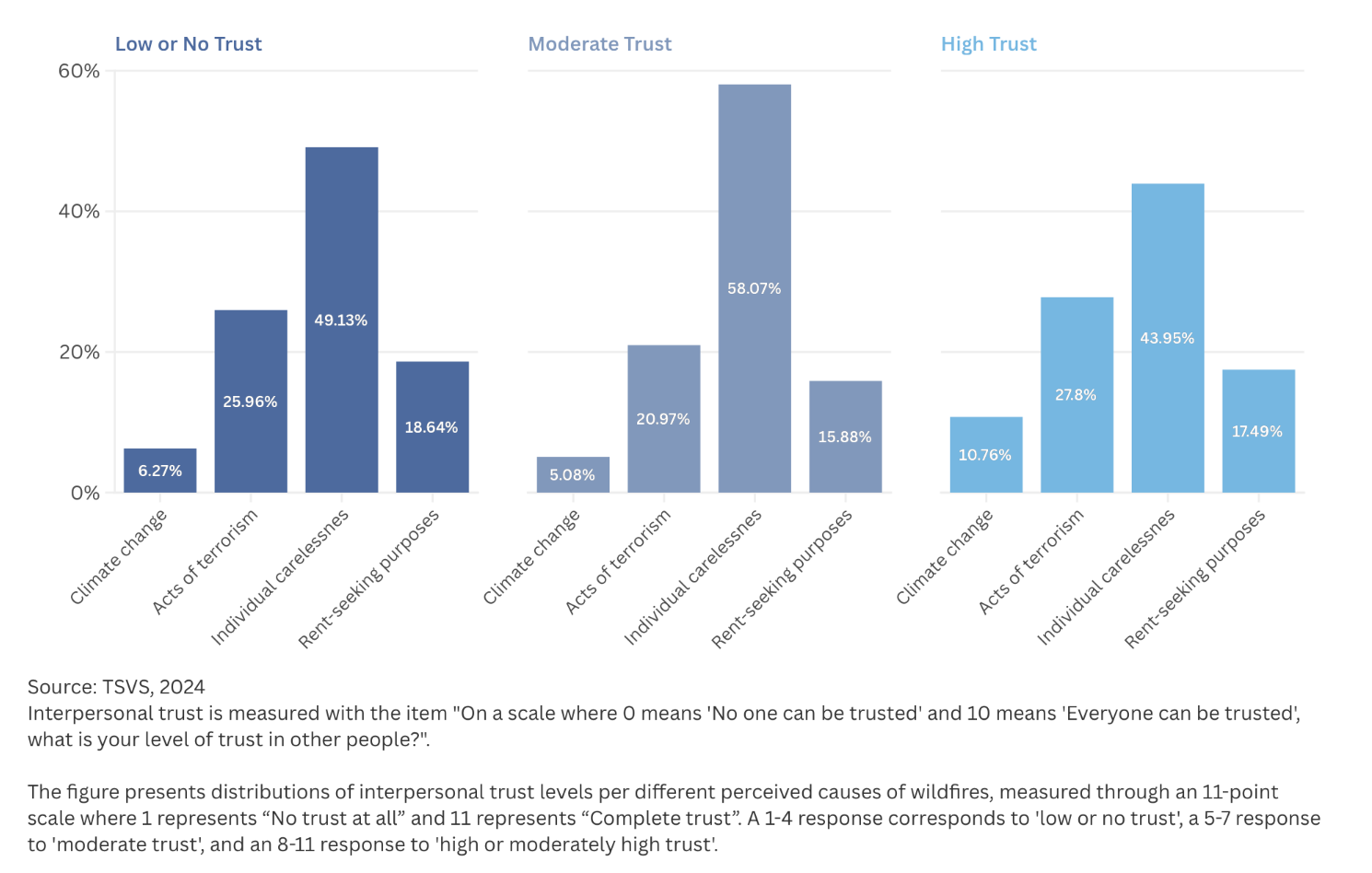
Figure 3 reports the percentages indicating perceptions on the most common cause for wildfires by participants’ interpersonal trust levels. Among all interpersonal trust levels, “individual carelessness” was most frequently cited by those who reported having moderate levels of interpersonal trust (58.07%). Although the differences are small between groups, “rent-seeking purposes” were reported the most by those who have low or no trust (18.64%). Further, individuals who have high or complete levels of interpersonal trust pointed to climate change as a cause (10.76%) more than the rest. Participants with high (27.80%) or low trust (26.96%) have reported “acts of terrorism” as the most common cause the most compared to participants with moderate trust.
These findings reveal that perceptions of wildfire causes in Turkey are shaped by gendered differences, political party-choice and interpersonal trust dynamics. Notable gender differences in causes of wildfires suggest new research directions for belief in conspiracy theories, and communication strategies that should take into account how gender influences alternative explanations for the cause of wildfires. Voting preferences and trust-based differences highlight how underlying beliefs and affiliations influence attribution patterns. Therefore, understanding public perceptions of wildfires requires not only examining environmental awareness and knowledge but also considering broader interpersonal and political attitudes.
Sociology Data Lab (SDL)
Boğaziçi University
References:
Ali, E., W. Cramer, J. Carnicer, E. Georgopoulou, N.J.M. Hilmi, G. Le Cozannet, and P. Lionello, 2022. "Cross-Chapter Paper 4: Mediterranean Region. In: Climate Change 2022: Impacts, Adaptation and Vulnerability." Contribution of Working Group II to the Sixth Assessment Report of the Intergovernmental Panel on Climate Change, edited by H.-O. Pörtner, D.C. Roberts, M. Tignor, E.S. Poloczanska, K. Mintenbeck, A. Alegría, M. Craig, S. Langsdorf, S. Löschke, V. Möller, A. Okem, B. Rama. Cambridge University Press.
Atmış, Erdoğan, Doğanay Tolunay, and Cihan Erdönmez. 2023. “Orman Yangınlarının Sayısal Analizi.” P. 38 in Orman Yangınları, edited by A. Kavgacı and A. Başaran. Türkiye Ormancılar Derneği.
Atmış, Erdoğan, Damla Yıldız, and Cihan Erdönmez. 2024. “A Different Dimension in Deforestation and Forest Degradation: Non-Forestry Uses of Forests in Turkey.” Land Use Policy 139:107086–86. doi: https://doi.org/10.1016/j.landusepol.2024.107086.
Ekberzade, Bikem. 2025. “İnsan Eliyle Başlayan Yangınlar, Çok Daha Büyük Alanlara Yayılıyor.” Bianet.org. Retrieved October 6, 2025 (https://bianet.org/haber/insan-eliyle-baslayan-yanginlar-cok-daha-buyuk-...).
Galliford, Natasha, and Adrian Furnham. 2017. “Individual Difference Factors and Beliefs in Medical and Political Conspiracy Theories.” Scandinavian Journal of Psychology 58(5):422–28. doi: https://doi.org/10.1111/sjop.12382.
Hürriyet. 2023. “DEM Parti kongresindeki terör propagandasına soruşturma...42 kişi gözaltına alındı.” Hürriyet. Retrieved October 10, 2025. (https://www.hurriyet.com.tr/gundem/adalet-bakani-yilmaz-tunc-dem-parti-k...).
Jones, Matthew W., John T. Abatzoglou, Sander Veraverbeke, Niels Andela, Gitta Lasslop, Matthias Forkel, Adam J. P. Smith, Chantelle Burton, Richard A. Betts, Guido R. Werf, Stephen Sitch, Josep G. Canadell, Cristina Santín, Crystal Kolden, Stefan H. Doerr, and Corinne Le Quéré. 2022. “Global and Regional Trends and Drivers of Fire under Climate Change.” Reviews of Geophysics 60(3). doi: https://doi.org/10.1029/2020rg000726.
Tam, Lisa, and Hyelim Lee. 2023. “From Conspiracy Orientation to Conspiracy Attribution: The Effects of Institutional Trust and Demographic Differences.” American Behavioral Scientist 68(10):000276422311743-000276422311743. doi: https://doi.org/10.1177/00027642231174330.
Tolunay, Doğanay. 2022. “Doğanay Tolunay: Otel İçin Orman Yakmaya Gerek Yok, Turizmi Teşvik Kanunu Var!” Artı Gerçek. Retrieved October 7, 2025 (https://artigercek.com/makale/doganay-tolunay-otel-icin-orman-yakmaya-ge...).
Türkiye Ormancılar Derneği. 2024. “Yangın İstatistikleri.” Ormancilardernegi.org. Retrieved October 5, 2025 (https://www.ormancilardernegi.org/Yangin).
Türkmen, Gülay. 2025. “When Wildfires Fan the Flames of Anti-Immigrant Discourse.” WZB. Retrieved October 9, 2025 (https://www.wzb.eu/en/publications/wzb-mitteilungen/im-angesicht-der-kli...).
Yıldızalp, Merve, and Yusuf Soykan Bal. 2025. “DMM, ‘Orman Yangınları ile ilgili İddialar ve Gerçekler’ bülteni hazırladı.” Anadolu Ajansı. Retrieved October 10, 2025 (https://www.aa.com.tr/tr/gundem/dmm-orman-yanginlari-ile-ilgili-iddialar...).