
Division of Household Labor in Turkey
Authors: Ladin Toplu and Ceylan Engin
Funders of research: Our project, coded 21B08SUP2, is funded by BU Scientific Research Projects..
Click here to access the PDF version of this report
This report examines whether beliefs about the equal sharing of household chores correspond to actual practices of domestic labor division in Turkey. First, participants' responses to the statement “Men should share the burden of housework and childcare equally with women” are evaluated to assess their views on the division of domestic labor. Then, to see how these views translate into daily life, the time married or cohabiting individuals spend on household chores each week is examined comparatively with the time their partners devote to these activities. This allows us to investigate whether attitudes and behaviors regarding the division of domestic labor are consistent.
The report uses data from the 2022 Turkish COVID-19 Values Survey (TCVS), which was conducted face-to-face with 1,500 participants. Only participants who were married or living with a partner were included in the analysis in order to examine the division of labor within the home. This group consists of a total of 777 participants, 770 of whom are married and 7 of whom live with a partner.
Attitudes Toward Domestic Labor
To measure participants' beliefs regarding gender roles in the context of domestic labor, they were asked to what extent they agreed with the following statement: “Men should share housework and childcare responsibilities equally with women.” Participants responded on a five-point scale, where 1 meant “strongly disagree” and 5 meant “strongly agree.”
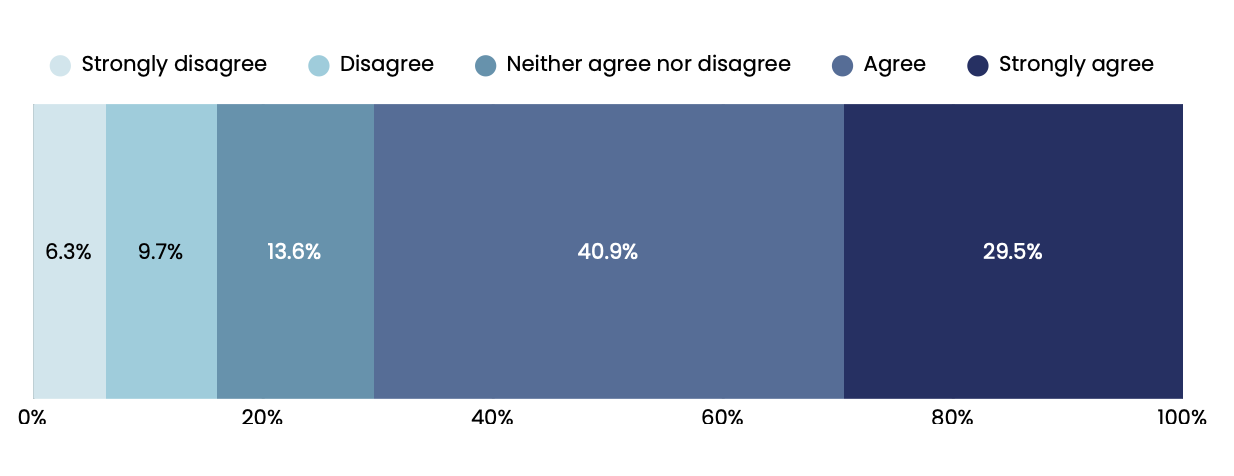
Figure 1 shows the distribution of responses to this statement. Approximately 70% of participants either “agree” (40.9%) or “strongly agree” (29.5%) with this statement, indicating that the majority believes men and women should share household and caregiving responsibilities equally. The total percentage of those who responded “disagree” or “strongly disagree” was only 16.0%. This distribution suggests that the idea of an equal division of labor is widely accepted in society.
Figure 1. Agreement with the statement “Men should share domestic and childcare responsibilities equally with women”
Time Spent on Domestic Labor
Participants were asked how much time per week they spent on household chores (e.g., preparing meals, cleaning, doing laundry, ironing). They responded by choosing one of the following categories: “None,” “1–3 hours,” “4–9 hours,” “10–15 hours,” “16–21 hours,” “22–30 hours,” or “30 hours and above.”
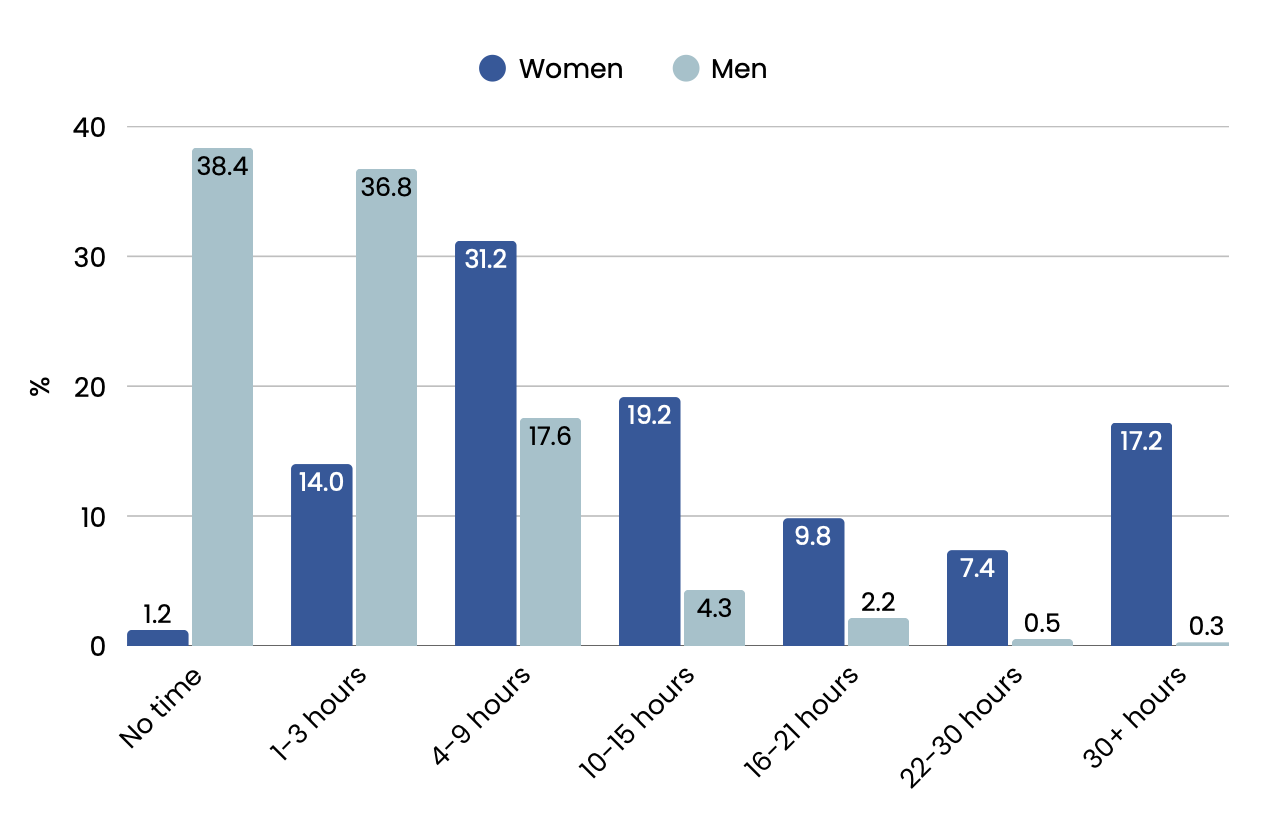
Figure 2 shows the number of hours participants spend on housework per week by gender. The majority of female participants reported spending more than 4 hours per week on housework, while the percentage of men doing so was significantly low. Approximately 17.2% of women stated that they do more than 30 hours of housework per week, 19.2% do 10–15 hours, and 17.2% do 16-30 hours. In contrast, approximately 36.8% of men stated that they do 1–3 hours and 38.4% stated that they do no housework at all. These findings show that domestic labor is distributed unequally between men and women, with most of the burden falling on women.
Figure 2. Average weekly hours spent on housework by gender
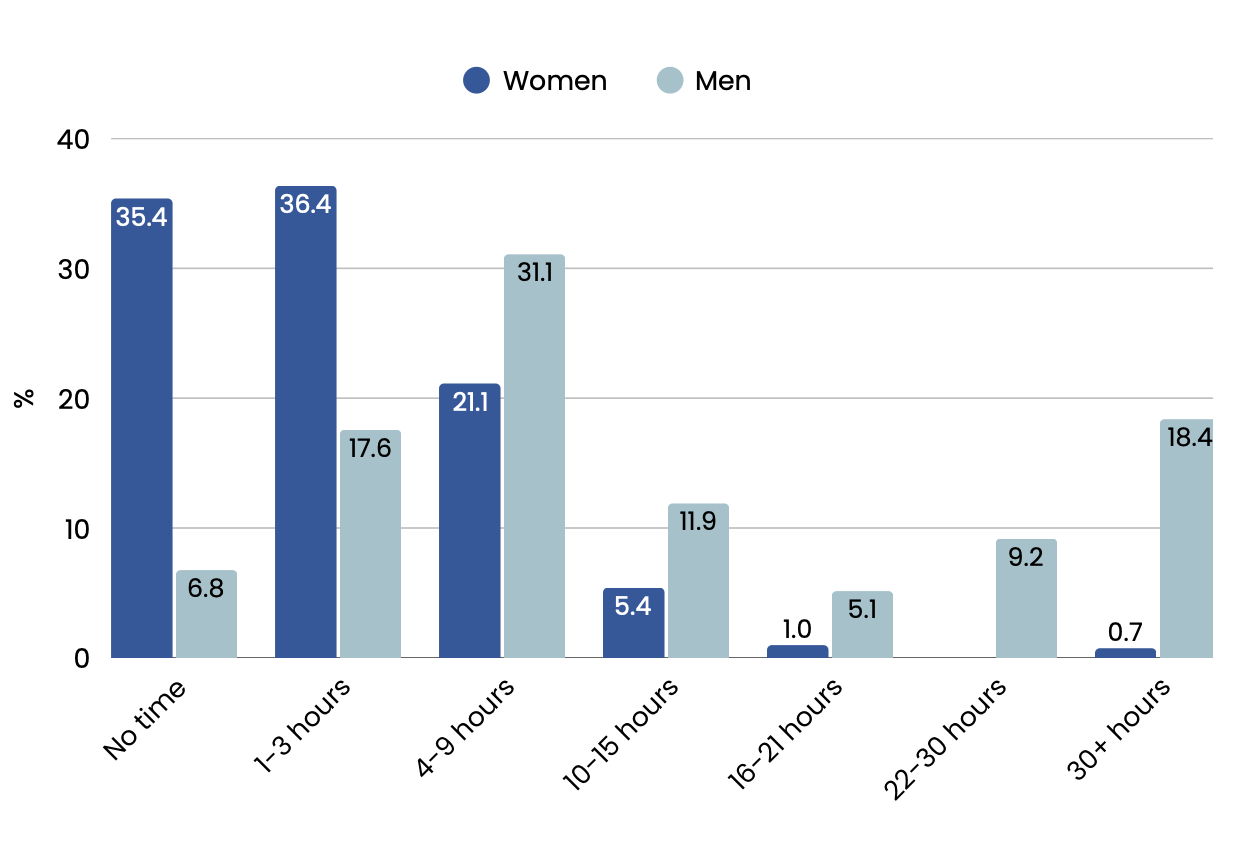
In addition, participants were asked how much time their partners spent on household chores each week. Figure 3 shows the distribution of these responses by gender.
A large proportion of female participants stated that their partners either did not spend any time on household chores (35.4%) or spent only 1–3 hours per week (36.4%). In contrast, male participants stated that their partners did much more housework: For example, 18.4% of men said their partner did more than 30 hours of housework per week, while 11.9% said their partner did 10–15 hours. In summary, while women rated their partners' contribution as quite low, men stated that their partners spent more time on housework.
Figure 3. Average weekly hours partners spend on housework, by respondent’s gender
Conclusion: The Gap Between Attitudes and Behavior
The findings show that, in Turkey, there is a significant discrepancy between participants’ attitudes toward gender equality regarding division of domestic labor and actual domestic labor practices. Approximately 70% of participants stated that men should share equal responsibility with women in housework, but this view is not reflected in their gender role behavior. Women spend significantly more time on average per week on housework; the majority of men, on the other hand, stated that they either do no housework at all (38.4%) or spend only 1–3 hours on it (36.8%). In contrast, approximately 85% of women spend at least 4 hours per week on household chores and 17% spend more than 30 hours per week on household chores. Although most men and women endorse egalitarian ideals, their everyday practices continue to reflect socially ingrained gender role behaviors. That is, despite the widespread acceptance of equal division of labor, domestic labor continue to fall disproportionately on women in Turkish society.
Sociology Data Lab (SDL)
Boğaziçi University