
Measures of Religiosity in Turkey
Authors: Gece Kaya, Ada Gülce Canıgüz, Ceylan Engin
*Department of Sociology, Boğaziçi University
Funders of research: Our project is funded by TUBITAK 1001, with the grant number 223K65.
Click here to access the PDF version of this report
Using the demographic data provided by the Turkish Social Values Survey (TSVS 2024), this report examines different dimensions of religiosity in the Turkish public. To emphasize the multidimensional aspect of religious belief, we look both at the importance of God and the importance of religion in one’s life, and the frequency of religious practices (salah and fasting) as measures of religiosity (Glock 2012). In the survey, the importance of God and religion was measured on a 10-point scale, while fasting was measured as the average number of days fasted during Ramadan. The frequency of salah was measured using a scale ranging from ‘never or almost never’ to ‘every day, five times or more.’ Both the frequency of salah and fasting were later recoded into ordinal categories for the purposes of this analysis.
Figure 1. Importance of God (N=1584)
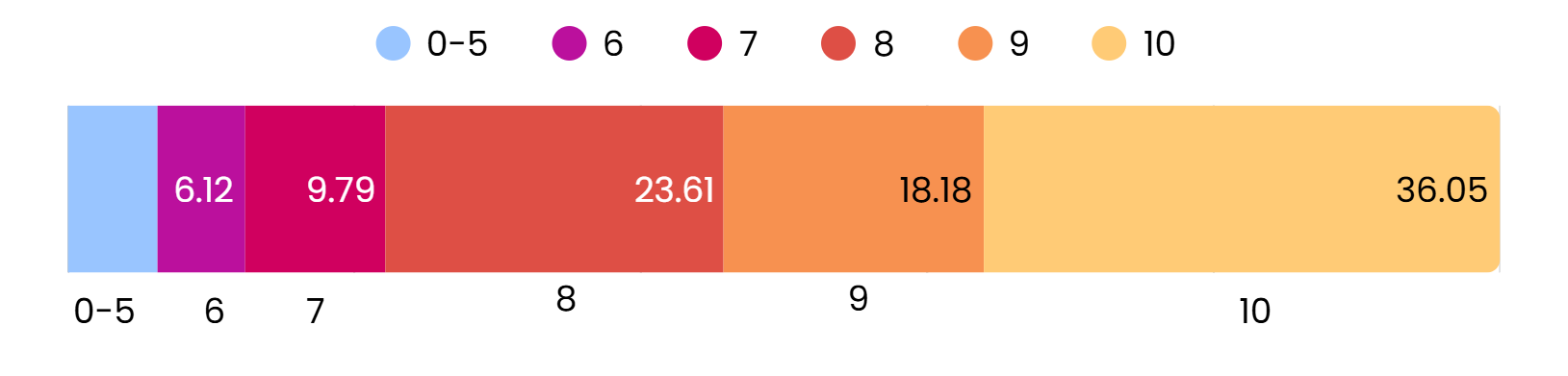
Figure 2. Importance of Religion (N=1582)
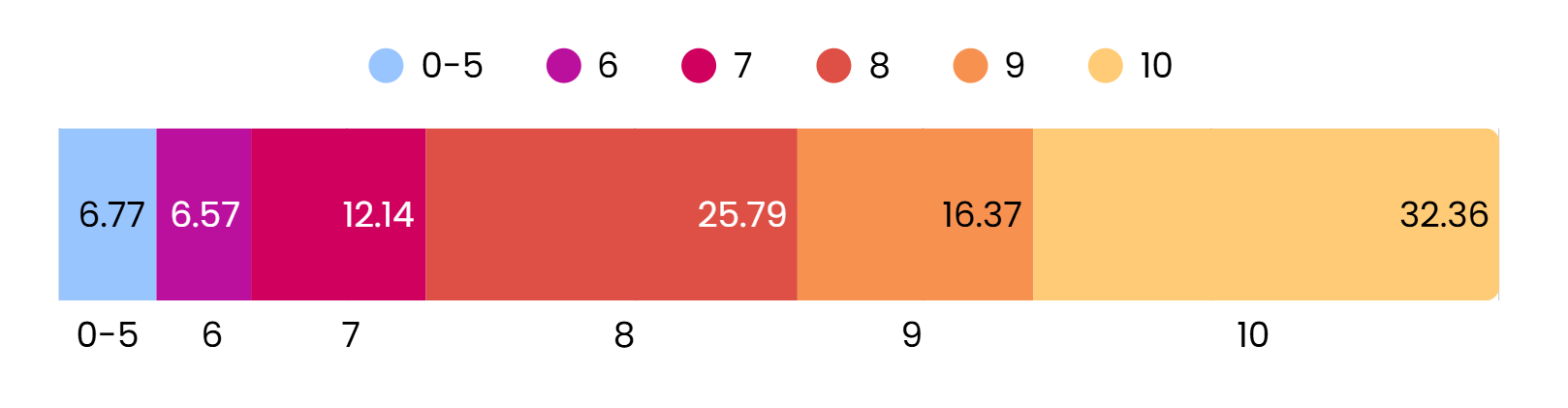
Figures 1 and 2 show respectively the self-attributed importance of God and religion to the respondents’ lives. Both figures show that an overwhelming majority of the Turkish public believe both God and religion to be important parts of their lives. On a scale of 0-10, 93.75% of the respondents reported the importance of God as above 5 with over half (54.33%) reporting the level as 9 or 10 with a mean of 8.46 (SD = 1.61).
The numbers are similar for the importance of religion with 93.23% reporting above a score of 5 and around half (48.73%) reporting it as 9 or 10 with a mean of 8.33 (SD = 1.60). With both means falling over 8 on a scale of 0-10 and with low levels of deviation from the mean, we can say that the average Turkish citizen values both God and religion high in terms of importance. It is important to note that religion in this context does not simply refer to Islam, but rather to the respondent’s own religion, although the data on Islamic practices suggests that Islam is the predominant religion implied.
Figure 3 Average days fasted during Ramadan (N=1561)
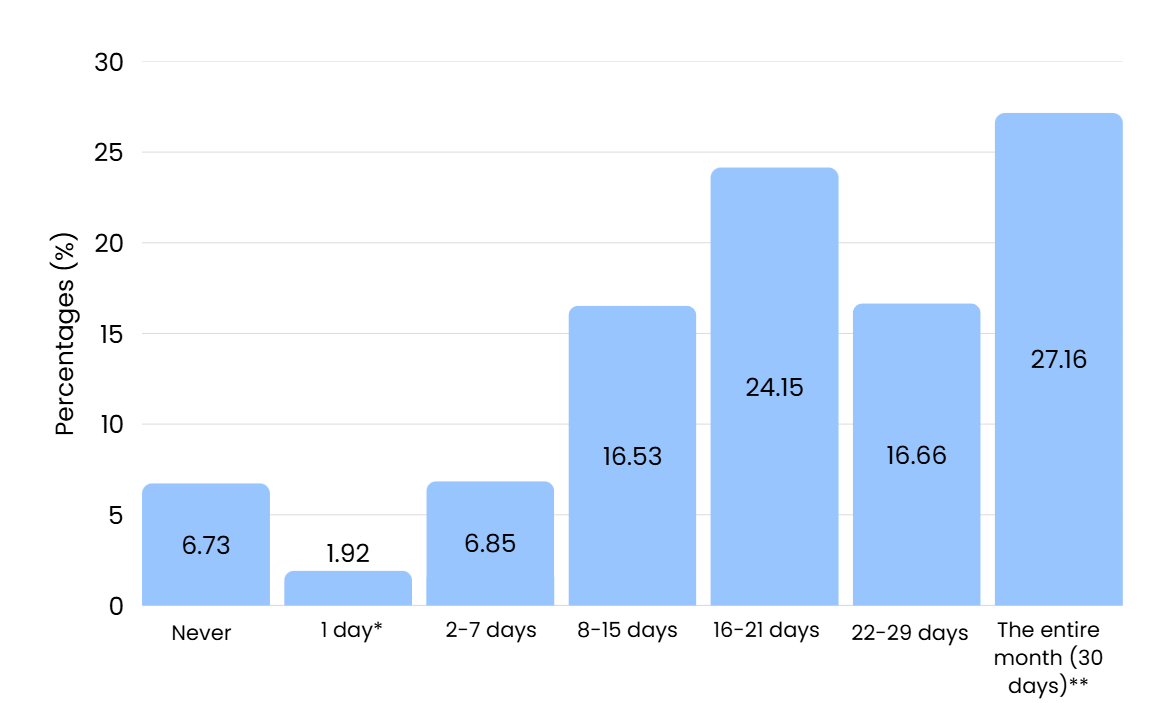
Figure 3 shows the amount of days the respondents fast during Ramadan on average. With only 6.73% reporting as never fasting, it is possible to say that the majority of the Turkish public fast to an extent during Ramadan. Almost half of the population (49.45%) report as fasting less than 22 days on average. In line with the findings of the salah frequency, it can be said that the Turkish Muslim religious performance is considerably unorthodox.
*While not confirmed, those fasting for 1 day could be attributed to the “Night of Power” towards the end of Ramadan, only fasting during which could be classified as a traditional act of worship.
**It is important to note that mensturation automatically prevents the majority of women from fasting a full month during Ramadan.
Figure 4. Average days fasted on Ramadan by age groups (N=1561)
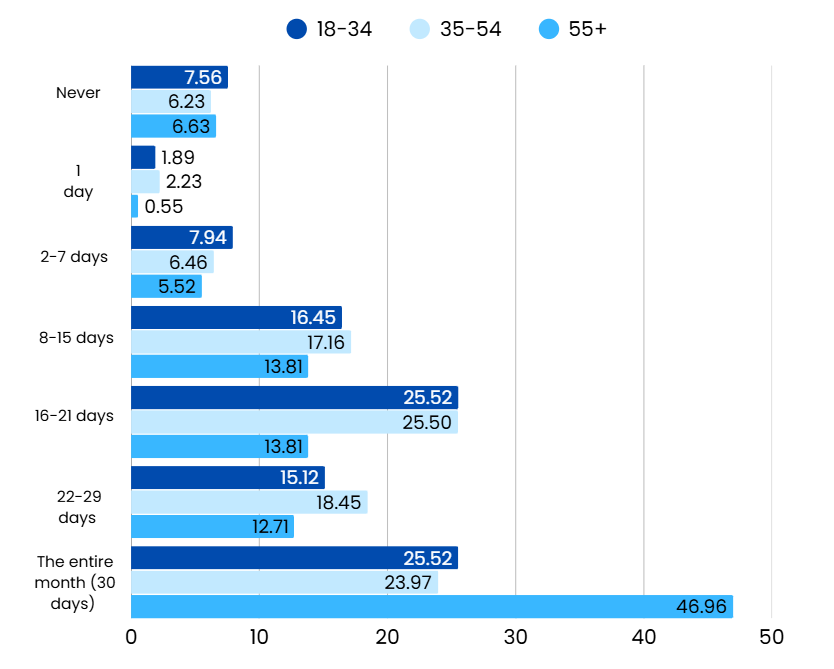
Figure 4 shows the days fasted during Ramadan on average by age groups. While health complications must be especially taken into consideration for those aged 55 and up, 46.96% reports as fasting the full month during Ramadan. While age groups 18-34 and 35-54 have considerable dispersions for irregular amounts of fasting, the oldest age group is consistently less irregular than the other two groups; thus supporting the argument that older people perform a comparatively more orthodox religiosity in terms of acts of worship.
Figure 5. Frequency of performing salah (N=1555)
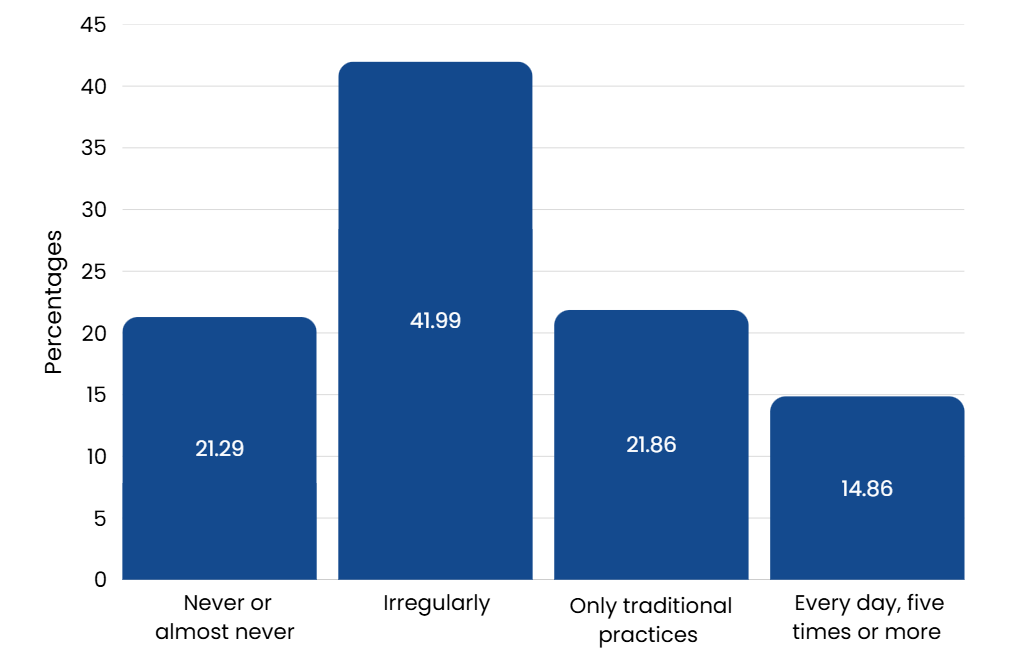
Figure 5 shows the frequency in which the respondents perform salah. As the religious orthopraxy is performing salah at least five times every day, the recoding was done to highlight the religious heteropraxies within Turkish Muslims. The category named “Only traditional practices” entails those who perform salah on Friday noons and on religious holiday mornings which provides a sample of all men. The “Irregularly” category is everybody who answered outside of the remaining three categories, entailing everybody who performs salah without a pattern. Only 14.86% of the population performs salah five times or more every day, with the remaining 85.14% delineating from “apt performance”. While those who only perform salah traditionally and those who never perform it are similar in size (21.86% and 21.29% respectively), the most populated category is those who perform salah irregularly (41.99%).
Figure 6. Frequency of salah by age groups (N=1555)
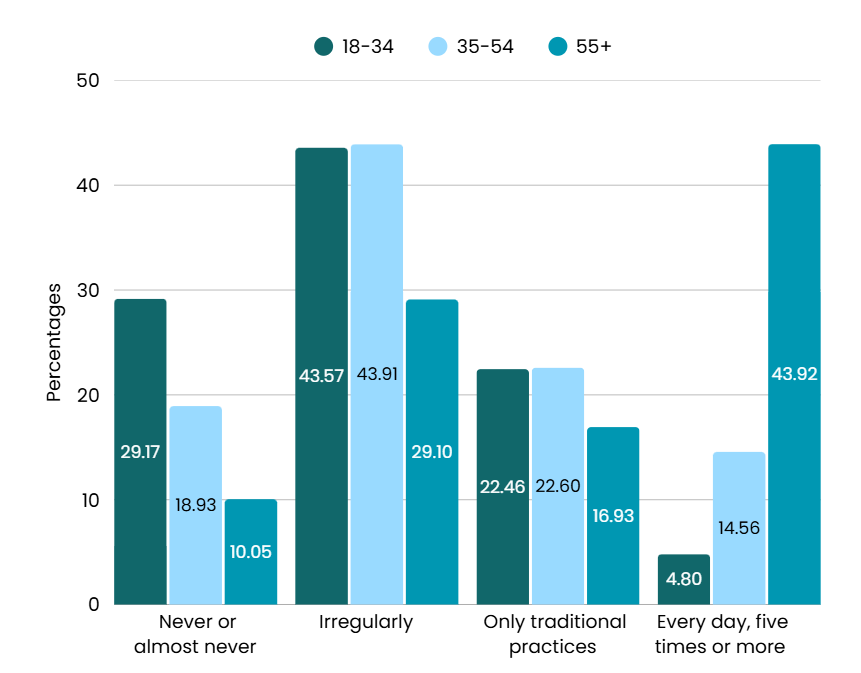
Figure 6 shows the frequency of performing salah by age groups. Within the youngest age group 18-34, those performing the salah regularly are the minority with only 4.8% while the biggest part claims to perform salah irregularly (43.57%). Among the three age groups, those aged 18-34 have the largest percentage of those who never perform salah (29.27%). Those aged 55 and above have the largest percentage of those who perform salah regularly (43.92%) while also having the lowest percentage of those who never perform (10.05%). Although there is no linear progression between age and performing salah; it is possible to say that older people tend to perform salah more regularly compared to younger adults, showing a tendency of a more orthodox religiosity.
Conclusion
The findings show that the Turkish public has a tendency for unorthodox religious practices such as infrequent and traditionalised worship over orthodox worship and over an abandonment of religious practices. While God and religion are both important values to the Turkish public, religious worship such as salah and fasting is followed more liberally with some traditional practices preferred over regular practice. Looking at religion as a social practice above the level of belief, it is possible to say that ways and levels of performing certain acts of worship are configured to be separate from what is prescribed as apt performance. Additionally, the findings show that those above the age of 55 have a tendency towards increased orthodoxy in worship.
Sociology Data Lab (SDL)
Boğaziçi University