
Romantic Relationships During COVID-19 in Turkey
Authors:F. Giray Demirci, Rabia Nur Önder, & Ceylan Engin
Funders of research: Our project, coded 21B08SUP2, is funded by BU Scientific Research Projects.
Click here to access the PDF version of this report.
This report examines the changes in romantic relationships during the COVID-19 pandemic in Turkey by using data from the 2022 Turkish COVID-19 Values Study (TCVS), conducted face-to-face with 1500 participants. Individuals were asked to evaluate changes in key aspects of their relationships, including tolerance levels, frequency of arguments or conflicts, emotional intimacy, sexual activity, and contraceptive practices.
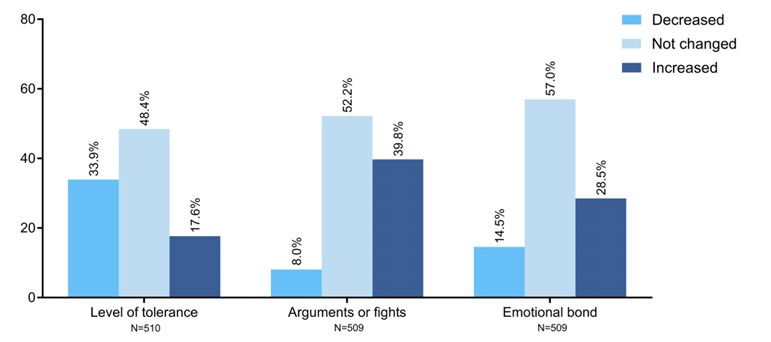
The findings show that although many couples maintained stable relationships during the pandemic, a significant number experienced difficulties, particularly more arguments or fights, while some reported an increase in emotional bonding (Figure 1).
Figure 1. Level of tolerance, frequency of arguments or fights, and emotional bonding during the pandemic Turkey, 2022
Source: TCVS 2022
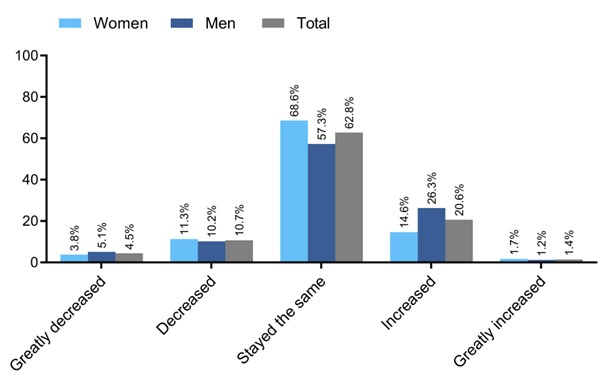
The majority of participants indicated that the frequency of their sexual activity remained the same during the pandemic. Examining gender differences reveals a striking contrast in the frequency of sexual activity between men and women: Only 16.3% of reported an increase in the frequency of their sexual activity compared to 27.5% of men (Figure 2).
Figure 2. Change in frequency of sexual activity during the COVID-19 Pandemic, Turkey, 2022 (N=485)
Source: TCVS 2022
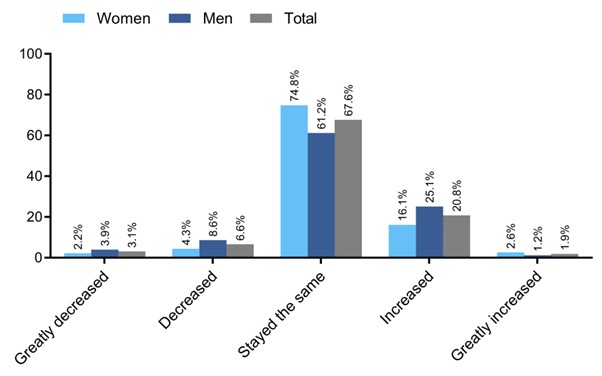
Similarly, the majority of participants reported no change in their use of contraceptive methods during the pandemic. However, a higher percentage of men (26.3%) reported an increase in contraceptive use compared to women (18.7%) (Figure 3). These findings align with research showing that men tend to overreport their sexual activity while women underreport it, especially in patriarchal contexts like Turkey1, highlighting the persistence of gendered sexual norms.
Figure 3. Change in contraceptive use during the COVID-19 pandemic, Turkey, 2022 (N= 494)
Source: TCVS 2022
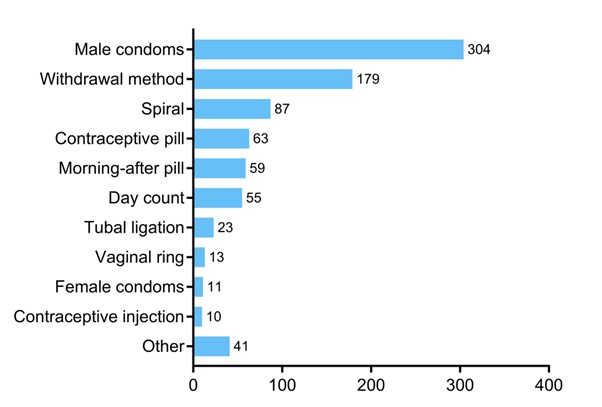
The results also show that an overwhelming majority of couples in Turkey rely on male condoms and the withdrawal method, followed by spiral and contraceptive pill (Figure 4)
Figure 4. Preferred method of contraception among respondents who use contraception, Turkey, 2022*
*Participants can select more than one option.
Source: TCVS 2022
1. Pals, Heili, and Ceylan Engin. 2018. “Attachment to Society and Cognitive Deviance: The Case of Turkey.” Deviant Behavior 39(6):799–815. doi:10.1080/01639625.2017.1411037.
Sociology Data Lab (SDL)
Boğaziçi University
socdatalab@bogazici.edu.tr